.svg)
Every spring we get a wave of the same phone calls. A skid steer that started fine in November won't move in April. A loader that was lifting full buckets in October now whines and leaks oil all over the trailer. A CAT with a clean dash all summer is suddenly stuck in limp mode with codes that won't clear.
This isn't bad luck. It's what happens when machines sit through five months of Vermont winter and then get asked to work hard on the first warm week of mud season. The good news is that most of what fails is predictable, and most of it can be fixed in a day or two if you call the right shop.
We work on Caterpillar and Bobcat skid steers and compact track loaders across Central Vermont and the Upper Valley. Some of that happens at our shop on Johnny Road in Topsham. A lot of it happens at job sites, dairy farms, and gravel pits between Bradford and Berlin. Here's what we see most often, what causes it, and what it actually costs to fix in 2026.
The short version: hydraulic leaks, drive motor seals, undercarriage wear, Tier 4 emissions issues, and fuel contamination account for most of the repair calls we get in spring. Costs run from under $200 for a simple hose to north of $4,000 for a wheel motor rebuild. If you're calling the dealer in Richmond, expect to wait two to four weeks before they even look at the machine. If you're calling us, the typical turnaround on a common repair is 24 to 72 hours.
Why spring is the worst season for skid steers in Vermont
A few things happen at once.
The seals in your hydraulic cylinders and engine spent the winter contracting in the cold, and the first time you run the machine hard they shear and leak. Fuel that sat half-full in the tank pulled condensation out of the air for months, and now you've got water and microbial growth feeding into your injectors. If you ran the machine during March mud, your undercarriage is full of grit, your tracks are stretched, and your rollers are worn.
Then there's the Tier 4 problem. Every CAT D3 series machine and most modern Bobcats need to run hot enough, long enough, to complete a regen cycle. If your machine sat through winter doing short cycles for snow work or didn't run at all, the DPF didn't get cleaned out properly. You'll find out the first time you load it up in April, when the dash lights come on and the power drops.
And finally there's the battery issue, which is more boring but no less common. Cold-cycled batteries don't fully recover. Half the time you find out at the trailer ramp on the way to the job, not in the driveway.
If you put the machine away running well and you can't get it to behave in April, you're not alone. The pattern is so reliable we plan our spring schedule around it.
The 8 most common skid steer repairs we see (and what they actually cost)
These are the calls we get most often, with cost ranges that reflect what we actually charge in Central Vermont in 2026. Your bill will vary depending on the model, the parts situation, and how far we have to drive.
1. Hydraulic leaks
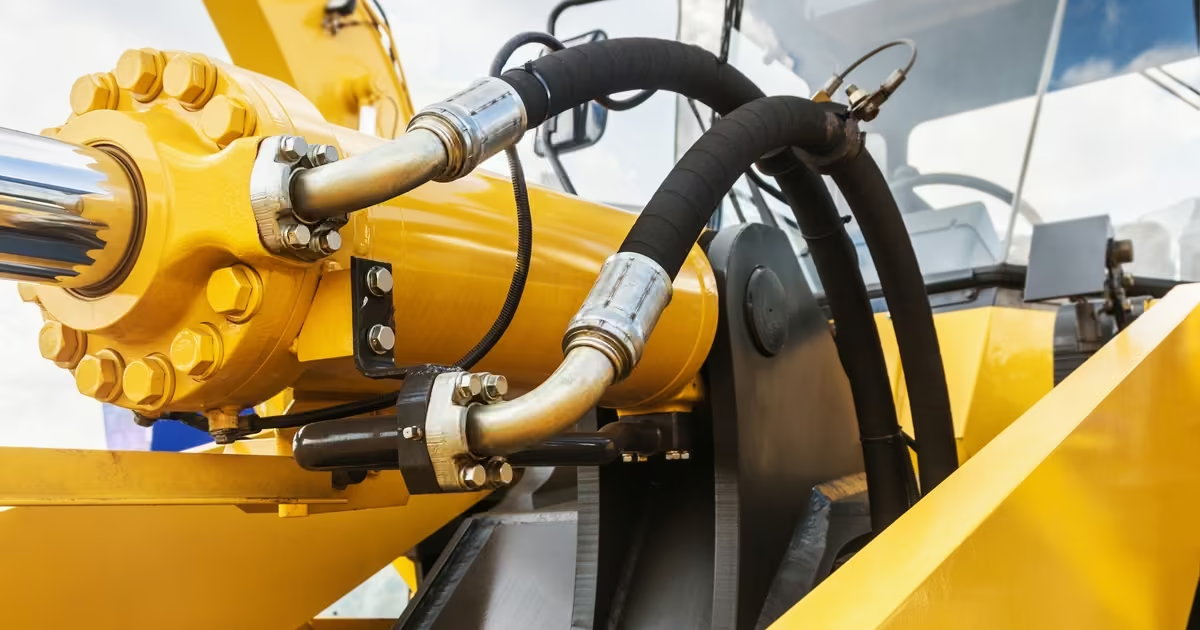
Hydraulic leaks are the number one call we get in spring. You'll usually spot oil under the machine, notice a boom that's slow or weak, or hear the pump whine when you pick up a heavy load. The most common culprit is a failed cylinder rod seal. Those are rated for about 3,000 to 5,000 hours, and Vermont winters age them faster than the spec sheet would suggest. The second most common is a hose that's been rubbing against a frame member for a season too long and finally gave up.
A hose replacement is usually a one- to two-hour mobile job and runs $200 to $600 with the trip included. A full cylinder reseal is a different animal. The gland needs a press, the work has to stay clean, and a typical reseal runs $600 to $1,500. Larger CTL boom cylinders push higher. If you can grab a video of the leak with your phone before you call, we can usually tell you over the phone whether you're looking at half a day or a full one.
You can swap a hose yourself if you know what you're looking at and have a torque wrench. Cylinder reseals are a shop job.
2. Drive motor and wheel motor seal failure
This one shows up as oil running down the inside of the wheel or sprocket, sluggish travel on one side, or a machine that won't track straight no matter how you trim the joysticks. The shaft seal has failed, usually after years of dust, mud, and pressure washing. It's especially common on Bobcat T-series machines and CAT 259, 279, and 289 models with 3,000 hours or more.
A reseal runs $800 to $1,800 depending on access and how bad the contamination is. If the motor itself has been damaged, you're looking at $2,500 to $4,500 or more for a full replacement or rebuild, especially on a CTL where the unit is heavier and harder to get to.
This is not a DIY repair. Drive motors are heavy, high-pressure, and tolerant of exactly zero installation mistakes.
3. Undercarriage wear on compact track loaders
Vermont mud and Vermont grit are very, very hard on rubber undercarriages. Rubber tracks usually last 1,200 to 2,000 hours, sometimes less if you spent the season working in stony soil. Rollers and idlers run 2,500 to 4,000 hours. When they start to fail, you'll see cord showing through the track lugs, idlers wobbling under load, rollers leaking oil, or tracks coming off in turns. Vibration when traveling is another giveaway.
A set of CTL tracks installed will run you $1,500 to $3,000 depending on size. Rollers and idlers, $1,200 to $2,500. Sprockets, $400 to $800 a side. You can swap tracks on a job site if you've done it before, but rollers and idlers are shop work.
The single best thing you can do to extend undercarriage life is check track tension regularly. Too tight wears everything faster. Too loose throws tracks. There's a sweet spot, and most operators run too tight.
4. Tier 4 fault codes, regen failures, DEF and DPF issues
If you have a CAT D3 series, a newer Bobcat M-series, or really any Tier 4 Final machine from 2014 or newer, you're going to deal with emissions system problems eventually. The most common symptom is reduced power and a dash light you can't clear. Sometimes the machine goes into limp mode. Sometimes regen cycles fail repeatedly. Sometimes you get a DEF quality alert.
The root causes are usually the same. The machine isn't running long enough or hot enough to complete regens. The DPF is clogged. The DEF is bad. A NOx sensor has failed. The CCV system is gummed up. It's usually one of those five.
A forced regen and code clear at your job site runs $250 to $500. Sensor replacements, DPF cleaning, and related repairs run $1,500 to $4,000 or more depending on what's actually wrong. You can't really DIY any of this — reading the codes properly requires factory or compatible diagnostic software, and the regen procedure varies by machine.
Honest take: Tier 4 has made modern machines more efficient and cleaner, but they're more delicate than the old mechanical CATs, and they don't like the way a lot of Central Vermont operators actually use them. Lots of short snow-removal cycles, lots of idle, low-load grading work — that's a recipe for incomplete regens. If you're seeing repeat regen issues, longer work cycles at higher load are part of the fix.
5. Fuel system contamination
A machine that's hard to start in spring, idles rough, smokes when you hit the throttle, or loses power under load is usually telling you the fuel system has water in it, or has microbial growth, or both. Sometimes it's just a primary filter that finally gave up after a winter of pulling sludge.
Filter replacement and a fuel drain on-site runs $150 to $400. If injectors are involved, you're looking at $1,500 to $3,500 or more depending on the model. You can change filters yourself if you know how to bleed the system properly. Injector work is shop-only.
The cheapest fix here is prevention. Top off your tank before storage, treat it for water and microbes, and don't leave half a tank of pump diesel sitting through five Vermont months.
6. Electrical and sensor problems
Salt, moisture, and vibration are not kind to wiring. Eventually you'll get a joystick function that drops out, a dash warning light with no obvious cause, or gauges that come and go. The usual suspects are corrosion in the harness, a failed sensor, a bad ground, or a joystick that's worn from years of use.
Mobile diagnostic and minor wiring is $200 to $500. Sensor replacement, $400 to $1,200. Joystick rebuilds run $600 to $1,400. Some of this is detective work, and the bills land where they land depending on how long the symptom takes to chase down.
7. Heat and air conditioning
You probably won't think about cab HVAC until the day you really want it. Then your blower won't run, the heater core is clogged, the A/C compressor clutch has failed, or you've got a slow refrigerant leak that's robbed the system. Blower and fan work runs $200 to $600. A full A/C repair with recharge runs $700 to $1,500.
This one tends to get triaged behind other repairs in spring. In July, it moves up the list quickly.
8. Auxiliary hydraulics and attachment plate
If your auger won't run, your grapple is sluggish, the attachment plate won't lock, or you're getting noticeably less flow on an attachment than book spec, the issue is usually contaminated quick couplers, an electrical fault to the lock cylinder, or a problem in the aux flow circuit. Coupler service runs $150 to $400. Plate or flow circuit work runs $400 to $1,200.
Worth saying: a lot of "the attachment won't run" calls turn out to be the attachment itself, not the machine. Check the simple stuff first.
CAT or Bobcat — which models we see most often
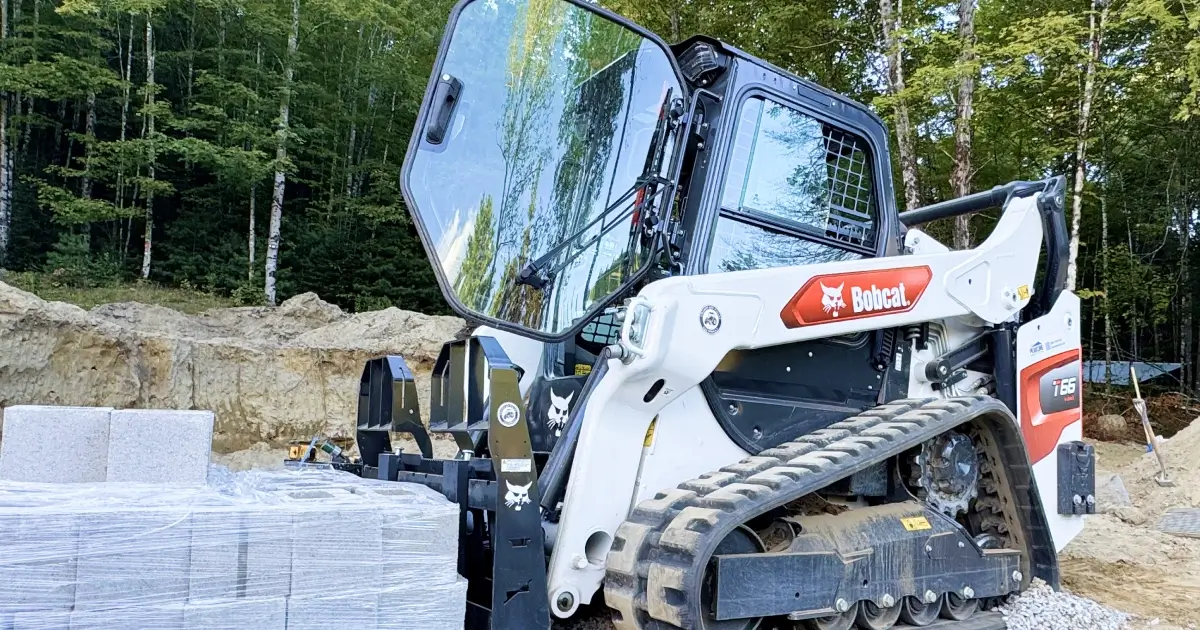
Across Central Vermont and the Upper Valley, the fleet leans heavily on Bobcat S-series wheeled skid steers and T-series compact track loaders, with Caterpillar D3 series machines (226, 232, 242, 259, 279, 289, 299) making up most of the CAT side. Older pre-D3 CATs and Bobcat 700- and 800-series machines are still common, especially on dairy farms and smaller contractor fleets.
Both brands are reliable when maintained. The newer machines from both manufacturers are where emissions and electronics work shows up. The older machines, especially anything pre-2014, are simpler — fewer codes, more wear-and-tear repairs, easier to keep running for a long time. Honestly, some of our favorite machines to work on are the 10-year-old CATs and Bobcats running on Vermont dairy farms. They're not complicated, and when something fails, you can see what failed.
What a repair should actually cost in Vermont
A few baseline numbers worth keeping in your head.
Mobile mechanics in Central Vermont generally bill $125 to $165 per hour, plus travel. The authorized CAT dealer in Richmond bills somewhere between $165 and $215 per hour, plus a per-mile or flat travel charge for mobile dispatch, plus a diagnostic fee that often lands between $150 and $300 just to plug in. Parts at the dealer are OEM at list price. Independent shops use OEM where it matters and quality aftermarket where it doesn't, usually at 10 to 25 percent less.
For a real example, take a Bobcat S650 with a leaking lift cylinder. Done at your job site as a mobile reseal, that's roughly $1,100 to $1,400 all-in, finished in a day or two. Hauled to the dealer in spring, the same job runs $1,500 to $2,000 once you add diagnostic, parts markup, and the trip — and your machine sits in their queue for two or three weeks.
For more on the cost gap and when each path actually makes sense, see our breakdown of independent mobile CAT repair vs. the dealer.
When mobile makes sense, and when it doesn't
We do a lot more mobile work than shop work, and the math usually favors it. If your machine is stuck on a job site, hard to trailer, or you can describe the symptoms clearly, mobile is almost always the right first call. Hydraulic leaks, electrical issues, filter and fluid service, Tier 4 code work, and most diagnostic calls fit well into mobile.
The repairs that really should come to the shop are the ones that need a press, a clean workspace, or significant disassembly. Cylinder rebuilds, drive motor rebuilds, major undercarriage replacement — that work goes better when we have a lift, parts staged, and a controlled environment. Sometimes we'll do the diagnostic mobile and recommend the machine come in for the actual repair.
How to avoid most of these repairs
Most of what we fix in spring could have been caught the previous fall. Top off your fuel and treat it before storage. Pull a hydraulic fluid sample at 1,000-hour intervals so you catch contamination before it costs you a pump. Grease pivots and pins on every shift. If a machine is going to sit through winter, cycle it every two or three weeks if you can. Run a full regen before parking it for the season. Check track tension before mud season, not after.
For the long version with a proper checklist, our Spring Startup Checklist for Excavators, Skid Steers, and Loaders in Central Vermont & New Hampshire walks through what to do and in what order.
FAQ
How much does CAT skid steer repair cost in Vermont?
For most common issues — hydraulic leaks, sensor failures, fuel system service — typical mobile repair bills run $400–$1,500 all-in. Major work like drive motor rebuilds or undercarriage replacement runs $2,500–$5,000+. Independent mobile rates are generally 15–30% below dealer rates in our area.
How long does a skid steer hydraulic repair take?
A hose replacement is 1–2 hours. A cylinder reseal is a half-day to a full day depending on access. A full hydraulic system flush and component replacement can take 2–3 days. Mobile turnaround on common repairs is usually 24–72 hours from call to back-in-service.
Can you repair a skid steer on site?
Yes — most hydraulic, electrical, filter, fuel, and Tier 4 code work can be done at your job site. We bring tools, parts, and diagnostic equipment to you across Central Vermont and the Upper Valley. Major drive-train and undercarriage work is usually better in the shop.
What's the typical life of a Bobcat or CAT skid steer?
Well-maintained skid steers and compact track loaders run 8,000–12,000 hours before they need major rebuilds. Light-duty homeowner machines can last decades; high-hour contractor machines reach those numbers in 5–8 years.
Do you work on all CAT and Bobcat models?
We service current and recent Bobcat and CAT skid steers and compact track loaders, including all D3-series CATs and Bobcat M-series and R-series machines. We also work on most pre-Tier-4 machines that are still in heavy use across the region.
Call Peakline for skid steer repair in Central Vermont
We're an independent, mobile-first CAT and Bobcat shop based at 18 Johnny Road in Topsham, serving Berlin, Montpelier, Barre, Randolph, Bradford, Plainfield, Northfield, Waterbury, the Mad River Valley, the Upper Valley, and most of Central Vermont and adjacent New Hampshire.
Call (802) 789-9168 for mobile service, repair quotes, or to schedule a diagnostic.