.svg)
People tend to imagine the first year on rural land as a year of beginnings.
And it is. But not always in the way they expect.
The first year is less about arrival than exposure. It is the year the property starts telling the truth. The driveway you thought was fine shows you where it washes. The low area you barely noticed in summer becomes impossible to ignore in spring. The access point that felt easy in a real estate showing becomes a more serious question when weather changes, a delivery is scheduled, or heavy equipment has to get in and out without creating a bigger problem. The beautiful piece of land starts introducing itself not just as scenery, but as terrain.
This is particularly true in Central Vermont, where the first year on rural land is rarely just a matter of settling in. It is usually a year of learning how the place behaves.
That behavior tends to reveal itself in four ways first: driveways, drainage, mud, and machinery.
Driveways are often the first reality check because they are not just a convenience. They are your first piece of infrastructure. They determine whether contractors can get to the site, whether deliveries can happen without drama, whether spring turns access into a problem, and whether every storm becomes a small management event. A driveway on rural land is not a detail around the house. It is what makes the house, the shop, the materials, and the next phase of work possible.
And in Central Vermont, driveways are never only about stone.
They are about slope, runoff, culverts, ditches, snow, shoulder conditions, and spring durability. A driveway that feels perfectly functional in dry weather may need grading, reinforcement, or drainage work once the freeze-thaw cycle has had its say. Many new landowners discover this too late — after ruts deepen, water starts moving where it should not, or a seemingly minor weakness becomes the thing everything else now depends on fixing.
Drainage is the second great teacher.
There is something humbling about realizing how much of rural land ownership is really about water. Not dramatic water necessarily, just ordinary water with persistence and gravity. The water that wants to cross a driveway. The water that sits where you hoped to stage materials. The water that turns a workable area into a muddy one. The water that reveals the hidden logic of a site faster than almost anything else.
New landowners often begin with a house in mind. The land begins with water.
Where does it go? Where does it collect? What does it do in thaw? What happens after a hard rain? What looked stable last month that now feels soft? These are not glamorous questions, but they are often the questions that decide how expensive, durable, and frustrating the first year becomes.
Then comes mud — the Central Vermont subject that sounds quaint until it becomes operational.
Mud season is not just an inconvenience for people with boots. It is a systems test. It tests access, assumptions, road entrances, shoulder strength, gravel choices, drainage planning, and whether the first version of your site work was truly enough. It also teaches something many people moving onto rural land do not fully understand at first: spring is not a neutral season. It actively rearranges the terms on which you use your property.
What worked in frozen conditions may not work in thaw. What held up under one kind of load may not hold up under another. A truck, trailer, or machine entering at the wrong moment can do more damage than expected. A problem that felt cosmetic in fall can become structural in spring.
And that is where machinery enters the picture.
It is striking how little the machinery side of rural land ownership gets discussed in the dreamy version of the story. People talk about cabins, gardens, views, chickens, and workshops. Much less often do they talk about the practical fact that almost every meaningful improvement to rural land eventually involves a machine.
Not necessarily ownership. But involvement.
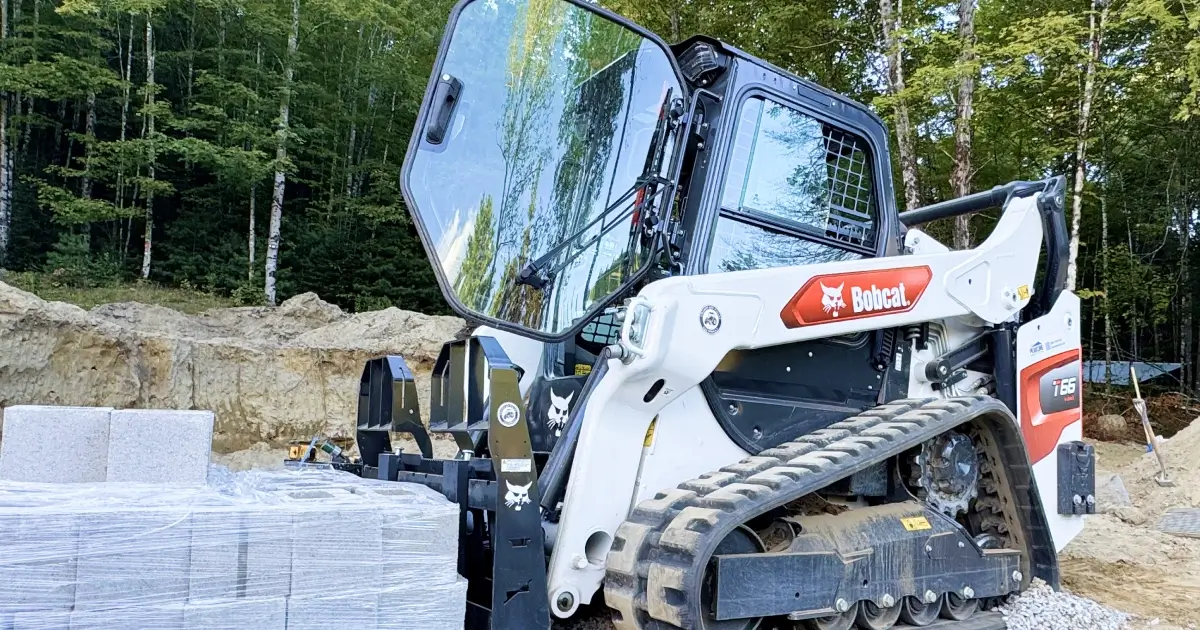
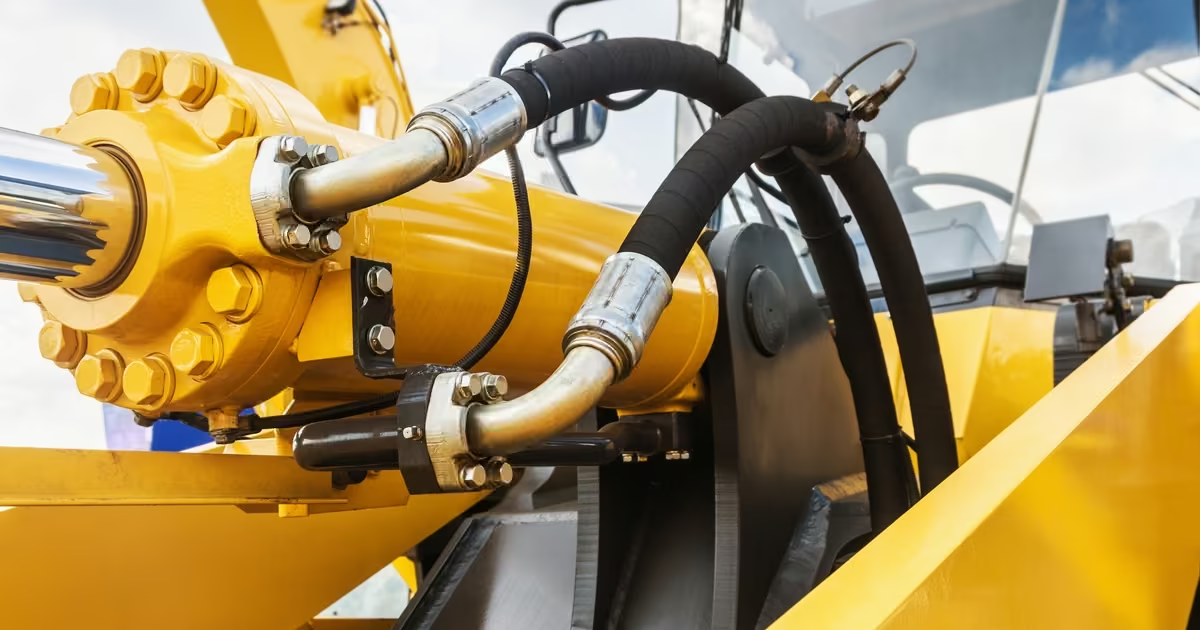
A skid steer, mini excavator, tractor, compactor, or other piece of equipment often becomes relevant much sooner than newcomers expect. Not because they are trying to run a jobsite full time, but because the first year asks for land shaping. Material movement. Access improvement. Drainage correction. Clearing. Grading. Small excavations that turn out not to be small. The work of turning a rough property into a livable one happens through tools, but it also happens through machinery.
That can be a surprisingly helpful realization.
For many people, the future they imagine on rural land is one of greater independence. Machinery can seem like the opposite of that — technical, expensive, maybe intimidating. In practice, it is often part of what makes that independence possible. The question is not whether machinery belongs in the story. It is how strategically a landowner learns to use it, rent it, hire it, or plan around it.
That is one reason the first year matters so much. It is not only about fixing what is wrong. It is about discovering what kind of property owner you are becoming. Some people learn they want to hire out almost everything. Some learn they want to be deeply hands-on. Most land somewhere in the middle: doing what makes sense themselves, bringing in help where needed, and slowly building a vocabulary around earthwork, access, grading, and upkeep that they did not have before.
That is not failure. It is fluency.
By the end of the first year, most people know much more than they did when they arrived. Not just about their land, but about the kind of ongoing relationship rural property requires. They know which section softens first, where runoff needs managing, whether the driveway needs another pass, what equipment would actually be useful, and which “small projects” are really infrastructure in disguise.
And that may be the real beginning.
The first year on rural land in Central Vermont is rarely tidy. It is educational, expensive in selective ways, and full of corrections. But it is also clarifying. It strips away the generic fantasy and replaces it with something better: a real understanding of place.
For Peakline, that first-year reality is exactly where the business has long-term relevance. Because before rural land becomes a settled life, it is usually a sequence of practical projects — access, grading, drainage, movement, support, and the machinery that helps make all of it possible.
That is the part nobody talks about enough.
It is also the part that tends to shape everything that comes after.