.svg)
When Your CAT Dozer, Loader or Yellow Iron Breaks Down on a Rural Vermont Jobsite
Rural Vermont jobsites are not always easy places to have equipment trouble.
A CAT dozer might be sitting on a logging road in Corinth. A loader might be down in a gravel yard outside Barre. A compact wheel loader may be needed for snow, material handling, or farm work in East Montpelier, Plainfield, Topsham, or Chelsea. A machine may be parked along a town road shoulder, behind a barn, on a sugarbush road, near a culvert washout, or halfway into a driveway project.
When that piece of yellow iron will not start, will not move, leaks oil, loses hydraulics, overheats, or throws a code, the first question is usually simple:
Can this be looked at where it sits?
For many Central Vermont contractors, farmers, municipalities, landowners, and property managers, mobile heavy equipment repair is the practical first step.
Peakline Rental & Repair provides mobile diesel repair and heavy equipment repair across Central Vermont and nearby parts of western New Hampshire. Peakline is an independent service provider and does not claim to be an authorized Caterpillar dealer or warranty center.
Rural Vermont Is Hard on Heavy Equipment
Vermont work is tough on machines because the ground, roads, weather, and seasons keep changing.
Vermont has more miles of dirt road than paved road, and freeze-thaw cycles, thawing soils, and traffic all contribute to rough spring conditions. Mud season usually runs from snowmelt into late spring, with soft surfaces and erosion risks in wet areas. Towns also post gravel roads during thaw periods to protect road surfaces from heavy traffic damage.
That matters when you are trying to keep a dozer, loader, excavator, or backhoe working. Mud gets packed where it should not. Gravel chews up tires, tracks, cutting edges, and undercarriages. Cold mornings expose weak batteries and electrical problems. Spring work puts everything under pressure at the same time.
A machine that ran fine in October may not be ready for March mud, April sitework, May driveway jobs, summer haying, fall cleanup, or winter snow work.
Why Hauling Is Not Always the First Move
There are times when hauling equipment to a shop is the right call. But in rural Vermont, hauling is not always simple.
The machine may not move. The boom may be down. The brakes may be locked. The road may be posted. The driveway may be soft. The jobsite may be on a hill, behind a gate, or reached by a narrow gravel road. The trailer may be tied up. The crew may be short one person. The machine may be too far into the site to load without another piece of equipment.
That is why mobile diagnosis has value. It helps answer the real question: is this a field repair, a parts repair, a maintenance issue, or a shop-level problem?
You may still end up hauling the machine. But you will be doing it with a clearer reason.
Common CAT Dozer and Loader Repair Needs
No-start and electrical issues
Dozers and loaders depend on healthy batteries, cables, grounds, sensors, switches, harnesses, starters, alternators, and machine controls. Caterpillar’s dozer maintenance guidance specifically calls out inspection of electrical cables, harnesses, and ground straps as part of routine maintenance.
In cold Vermont weather, weak electrical systems become obvious. A machine that cranks slowly, clicks, loses display power, or starts only sometimes needs diagnosis before it fails completely.
Hydraulic leaks and weak implement movement
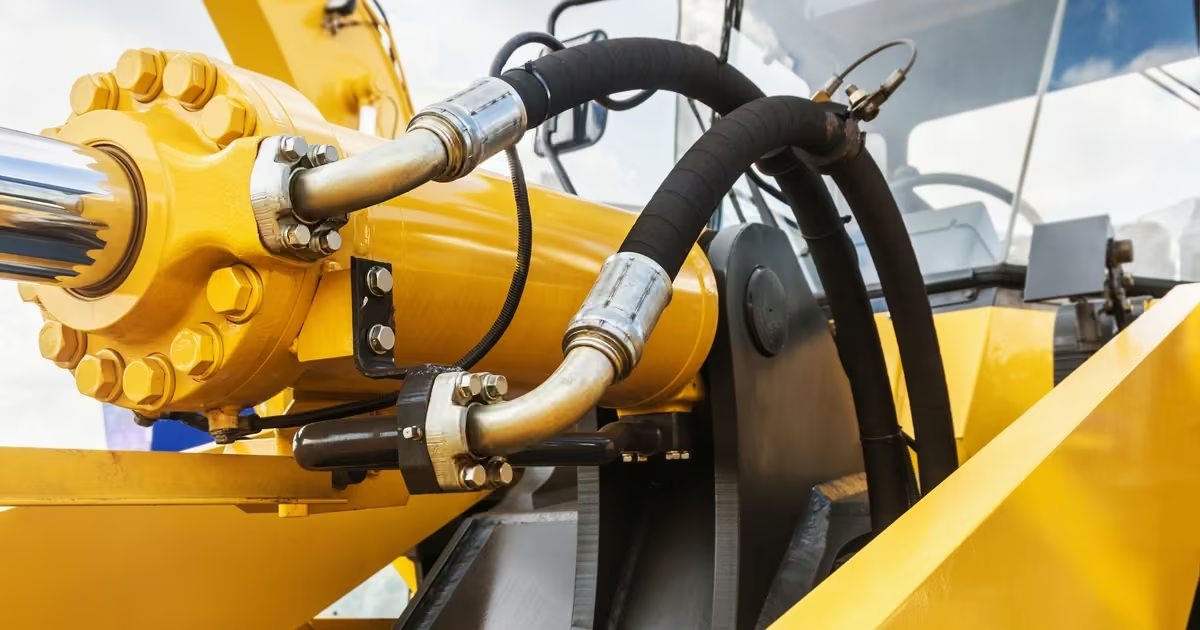
Loaders, dozers, and other CAT machines rely on hydraulics for lift, tilt, blade control, steering, auxiliary functions, and attachments. A small leak can become a big problem when a machine is working every day.
Warning signs include oil on the ground, weak blade movement, slow loader arms, drifting cylinders, noisy pumps, hot hydraulic oil, or attachments that do not respond correctly.
Undercarriage, track, tire, and drive problems
Dozers live on their undercarriages. Loaders live on tires, axles, brakes, wheel ends, and driveline components. Mud, rock, gravel, frozen ruts, road shoulders, and heavy pushing all add stress.
Caterpillar’s excavator undercarriage materials note that hard materials, moisture, operating stress, slopes, and attachments can accelerate undercarriage wear. The same general field reality applies to tracked machines working in Vermont conditions.
Overheating and cooling system trouble
Rural jobs create debris. Hay, chaff, road dust, mud, leaves, wood chips, and snow can all clog cooling areas. A machine that overheats under load may have a plugged radiator or cooling pack, low coolant, a belt or fan issue, a thermostat problem, a water pump concern, or another engine-related problem.
Running hot is not something to “watch for a while” when the machine is under load.
Loader arm, bucket, blade, and attachment issues
Loader arms, pins, bushings, buckets, cutting edges, quick couplers, dozer blades, rippers, and attachments all take abuse. A worn pin, loose cutting edge, cracked bracket, or damaged coupler can quickly become unsafe or expensive if it is ignored.
For municipalities, excavation crews, farms, and property managers, these issues often show up during the busiest part of the season.
Machines and Crews That Benefit from Mobile Repair
Mobile CAT equipment repair makes sense for:
- Excavation and sitework contractors.
- Septic and drainage crews.
- Municipal road crews.
- Farms and dairy operations.
- Maple operations and sugarbush access roads.
- Logging-road and land-clearing projects.
- Property managers with private roads.
- Gravel-yard and material-handling work.
- Storm cleanup and washout repair.
- Winter snow and plowing support.
Caterpillar lists compact wheel loaders for work including general construction, material handling, snow removal, landscaping, agriculture, and municipal use, which lines up closely with how many Vermont crews use loaders year-round.
When Mobile Repair Makes Sense
Call for mobile repair when:
- The machine will not start.
- The machine will not move or is unsafe to move.
- A hydraulic leak shows up on-site.
- The machine is overheating.
- A warning light or fault code appears.
- Tracks, tires, brakes, or drive components are acting up.
- The machine is on a rural road, farm, jobsite, or property where hauling is difficult.
- You need to know whether the machine can be repaired in place.
A mobile mechanic can often help with diagnostics, hydraulic issues, electrical checks, cooling problems, hose concerns, leak inspection, starting problems, maintenance, and certain field repairs.
Major component repairs, deep engine work, contaminated systems, or jobs needing heavy shop equipment may still need to happen off-site. The point is to make that call after a real inspection, not a guess.
What to Tell Peakline When You Call
The more information you provide, the better the first visit can be.
Have this ready if possible:
- Machine type, make, and model.
- Serial number.
- Engine hours.
- What the machine was doing when the problem started.
- Whether it starts, moves, steers, lifts, or tracks.
- Any warning lights or fault codes.
- Photos of leaks, damage, tracks, tires, hoses, or screens.
- Jobsite location and access notes.
- Whether the road or driveway is soft, posted, steep, gated, or narrow.
A short video can also help, especially for noises, leaks, smoke, warning lights, or movement problems.
Call Peakline for Mobile CAT Equipment Repair in Rural Vermont
If your CAT dozer, loader, excavator, skid steer, compact track loader, or other yellow iron is down in Central Vermont, call Peakline Rental & Repair.
Peakline helps contractors, farms, municipalities, landowners, and property managers get practical answers without automatically hauling a dead machine long distances.
Call Peakline Rental & Repair for mobile heavy equipment repair, CAT equipment diagnostics, diesel repair, hydraulic repair, and preventive maintenance across Central Vermont and nearby New Hampshire.
Cat and Caterpillar are trademarks of Caterpillar Inc. Peakline Rental & Repair is an independent service provider and is not affiliated with Caterpillar or its dealer network.
FAQ
Can mobile repair help with a CAT dozer that will not move?
Yes, depending on the issue. A mobile visit can help diagnose starting, electrical, hydraulic, drive, undercarriage, brake, or fault-code problems and determine whether the machine can be repaired in the field.
Who repairs CAT loaders in Central Vermont?
Peakline Rental & Repair provides independent mobile heavy equipment and diesel repair across Central Vermont, including areas around Topsham, Barre, Montpelier, Berlin, Bradford, Randolph, Orange, Plainfield, East Montpelier, and nearby towns.
What should I do if my machine breaks down on a gravel road or farm lane?
Stop using the machine if continued operation could cause damage or create a safety issue. Take photos, note the location and access conditions, and call for mobile diagnosis before trying to force the machine onto a trailer.